


 57 Huynh Thuc Khang - Dong Da - Hanoi
 02435533388
 vnptit@vnpt.vn

 Contact
Vietnam Cybersecurity Day 2026: Building trust in the AI era
On August 14, 2026, VNPT Cyber Immunity (VCI) participated in activities marking Vietnam Cybersecurity Day 2026, themed "For a humane cyberspace for everyone." At the event, a VCI representative shared insights on AI Security, emphasizing the need for safety controls as artificial intelligence increasingly gains the ability to make decisions and execute actions independently.
The series of activities marking Vietnam Cybersecurity Day 2026, organized by the Vietnam Cybersecurity E-magazine, aims to raise awareness and promote the responsibility of agencies, organizations, businesses, and users in building a safe and healthy digital environment.
Amid the rapid development and widespread adoption of artificial intelligence, ensuring cybersecurity is no longer merely a matter of protecting traditional IT systems. As AI gains access to data, integrates into business processes, and assists humans in decision-making, organizations must establish governance frameworks tailored to these emerging risks.
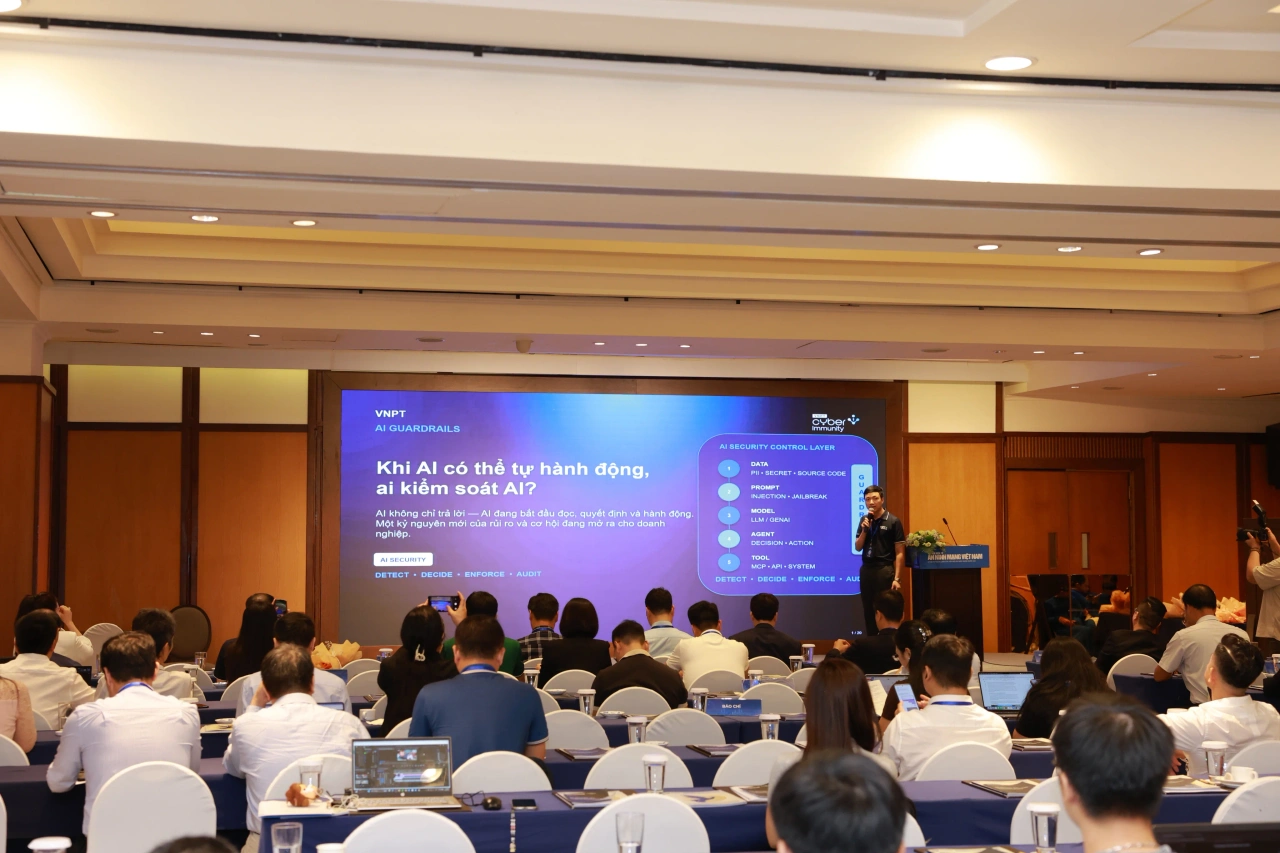
When AI Shifts from Responding to Acting
At the conference "Building Digital Trust – Vietnamese Enterprises Joining Hands to Protect Users," expert Vu Manh Kiem from VCI presented a paper titled "AI Security: When AI Can Act Independently, Who Controls It?"
The presentation addressed a topic of growing interest in the development and application of AI: the technology is evolving from a tool that merely responds to requests into a system capable of reading data, analyzing situations, making decisions, and executing actions within its authorized scope.
While traditional chatbots primarily generate content for user reference, next-generation AI systems can connect directly to databases, applications, and business processes. AI can search for information, process requests, execute tasks, or coordinate multiple tools to achieve a specific objective.
Greater autonomy expands the scope of AI applications but also imposes stricter safety requirements. A single erroneous instruction, compromised input data, excessively broad access privileges, or unsupervised actions can lead to consequences far more serious than merely an incorrect answer.
Expert Vu Manh Kiem from VNPT Cyber Immunity presents a paper on AI security at the conference.
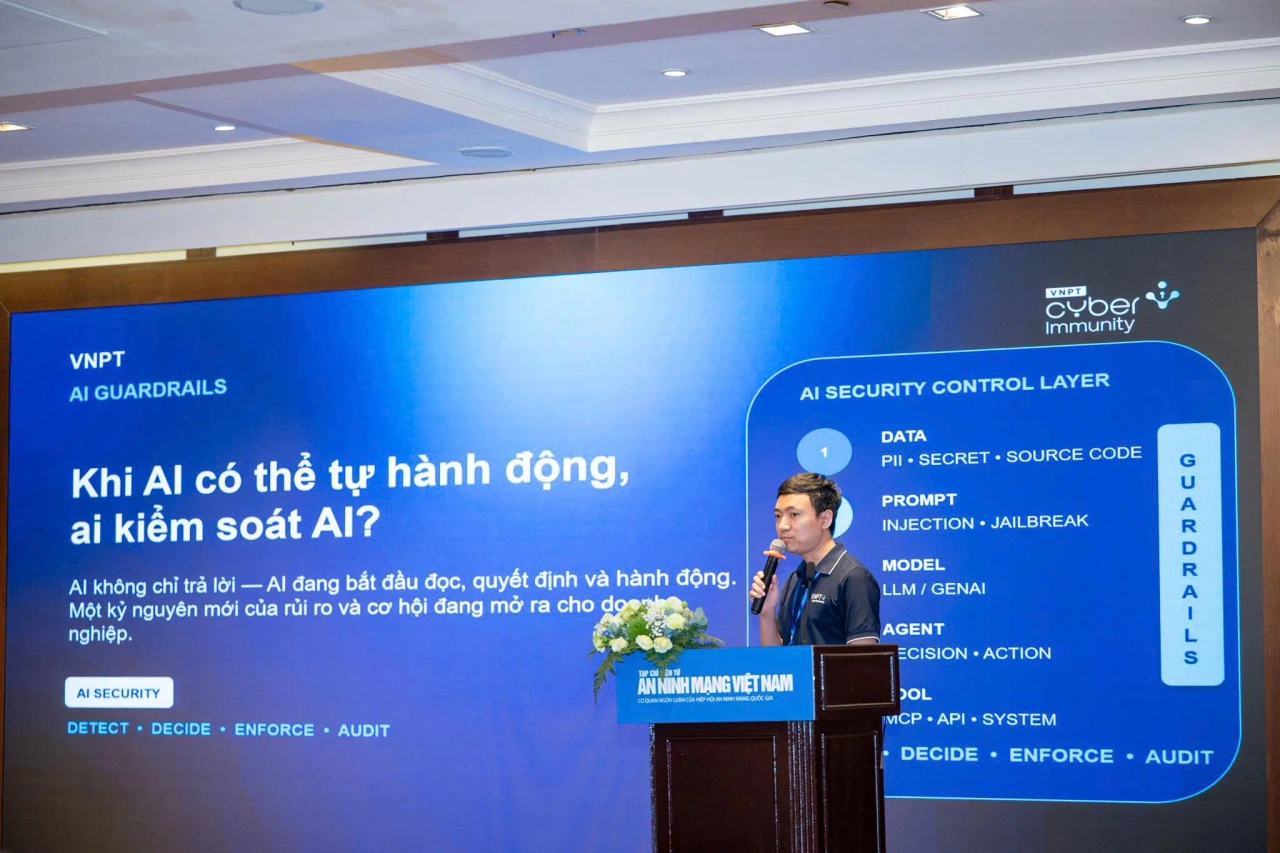
The more autonomous the AI, the clearer the control mechanisms must be.
The question "Who controls AI?" goes beyond algorithms; it is a comprehensive challenge involving people, data, access rights, operational processes, and accountability.
When deploying AI, enterprises must clearly define which data sources the system can access, what actions it can perform, and under what circumstances human approval is required. Privileges should be strictly limited to specific tasks, while critical activities must be logged, monitored, and traceable.
Furthermore, AI input and output data must be protected throughout the processing lifecycle. Mechanisms for testing, risk assessment, and incident response should be designed from the outset, rather than added only after the system is already operational.
Humans remain central to this entire process. AI can assist in analyzing and automating various tasks; however, organizations must clearly define who is accountable for final decisions—particularly regarding activities that impact customer data, assets, and rights, or business operations.
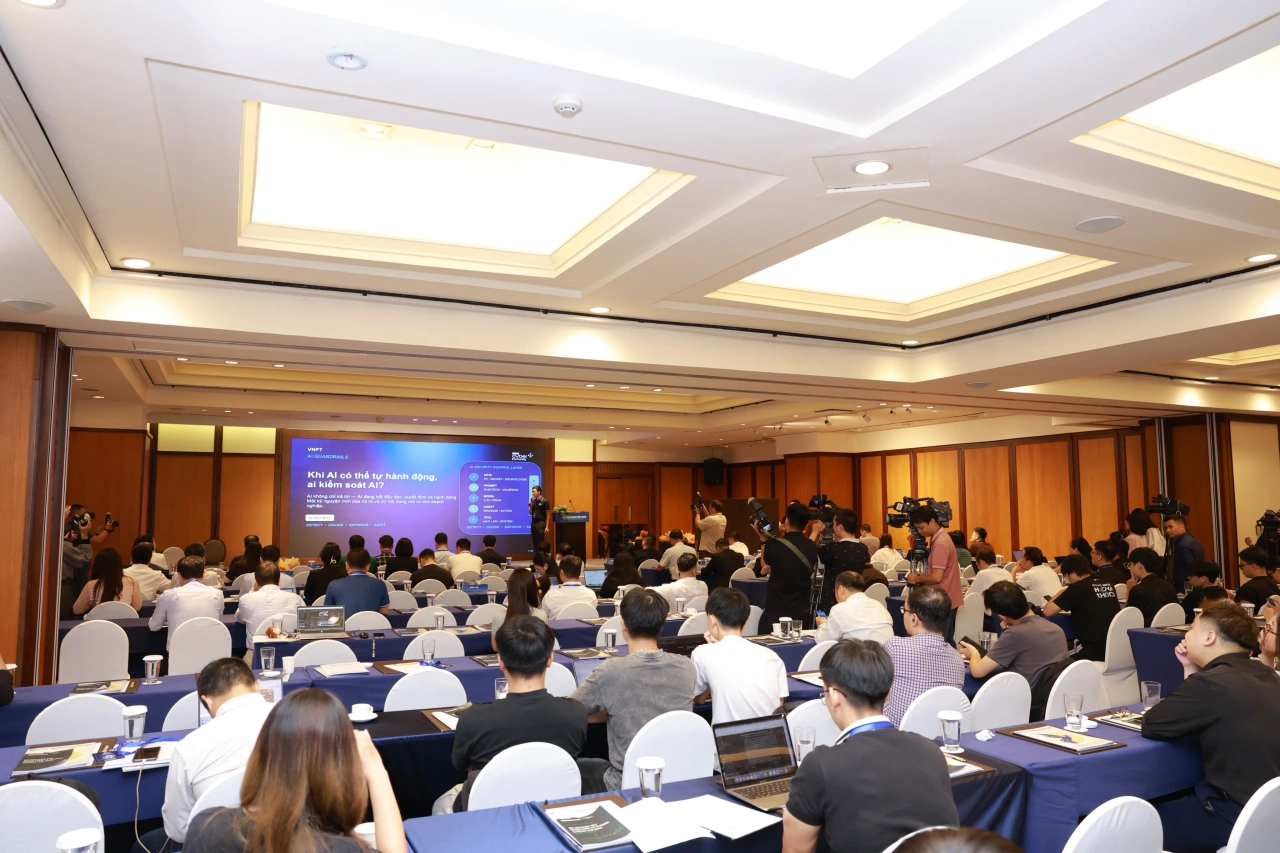
Safety is the Foundation of Digital Trust
Digital trust is built on more than just rapid operational capabilities or convenient user experiences. Users and businesses need to know how their data is protected, the operational boundaries of AI systems, and who bears responsibility when errors occur.
Therefore, AI security must be viewed as an integral part of the AI system lifecycle—spanning design, development, and testing through to deployment and operation. A proactive approach enables businesses to identify risks early, establish appropriate control mechanisms, and more effectively harness the value AI delivers.
By participating in Vietnam Cybersecurity Day 2026, VCI continues to share knowledge, experience, and professional insights with the business community. This initiative helps foster the understanding that innovation and security must go hand in hand.
As AI becomes increasingly autonomous, the requirements for protection and control must be heightened. This serves as the foundation for technology to thrive while remaining safe, transparent, and trustworthy, thereby helping to create a human-centric cyberspace for everyone.