


 57 Huynh Thuc Khang - Dong Da - Hanoi

 02435533388
 vnptit@vnpt.vn


 Contact
Applying artificial intelligence (AI) to large-scale data processing, VNPT-IT collaborated with VNPT Can Tho and VNPT An Giang to implement the digitization of diplomas and certificates for the education sector in the two localities. With nearly 200.000 pages of documents processed, the solution not only helps shorten data entry time and enhance productivity, but also contributes to standardizing data to serve management, lookup, and diploma verification in the digital environment.
Solving the problem of large-scale educational data digitization
In the digital transformation process of the Education sector, building a database of diplomas and certificates (VBCC) plays an important role in modernizing management, storage, and information verification. However, digitizing a large volume of records created over many periods with inconsistent templates and document quality poses numerous challenges regarding technology, human resources, and implementation progress.
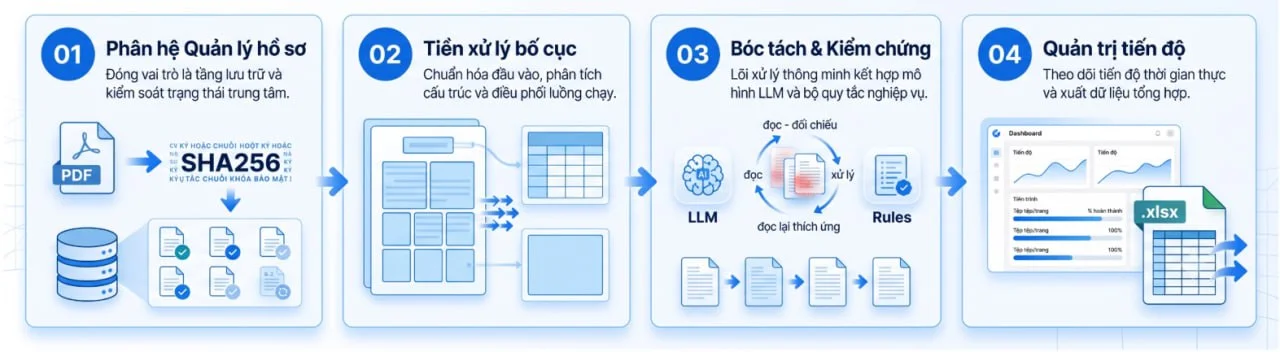
Faced with that requirement, VNPT-IT, directly the MDS Center, coordinated with VNPT Can Tho and VNPT An Giang to deploy a digitization solution VBCC for the Departments of Education and Training in both localities, applying the VNPT eDIG platform combined with multimodal AI technology to automate the recognition, extraction, and standardization of data.
In Can Tho, the project digitized more than 52.000 document pages in 20 days. Meanwhile, the volume in An Giang is expected to exceed 150.000 pages, with a similar implementation timeline.
Notably, the data source spans from 1985 to 2025, including THPT graduation diplomas, THCS, and many different types of certificates. The system had to process approximately 80 forms and archival registers with numerous complex characteristics, such as old documents that were faded or stained, handwritten text, inconsistent tables, or information spread across multiple pages.
The specific nature of VBCC data requires high accuracy, especially for critical fields such as full name, date of birth, diploma/certificate number, and registry book number. Therefore, the solution focuses not only on processing speed but also emphasizes the ability to check, cross-reference, and ensure the consistency of output data.
Applying AI, increasing processing productivity by 10 times
A highlight of the implementation process is the application of multimodal AI to recognize and extract data from forms with complex structures.
Through the VNPT eDIG platform, the system is capable of automatically analyzing document layouts, recognizing tables, identifying information fields, and linking data across multiple pages. The AI technology also supports processing low-quality image regions, recognizing abbreviations, and standardizing results according to business requirements.
Instead of manually entering data page by page, the process has shifted to a model where AI performs data extraction, while personnel focus on checking, cross-referencing, and verifying results. This approach significantly reduces repetitive tasks while enhancing quality control across the entire volume of records.
According to initial recorded results, the system has processed more than 5.758 document files, equivalent to approximately 200.000 pages, with a continuous extraction runtime of over 100 hours. Optimizing the recognition model combined with four parallel processing threads has enabled productivity to reach over 1.000 pages/hour.
In particular, according to the project team's assessment, processing speed can reach approximately 10 times faster than manual data entry methods, with the accuracy rate of data fields recorded at around 95%. The system also applies an automatic cross-referencing mechanism based on business rules to detect missing, incorrect, or duplicate information before proceeding to the professional review stage.
These results demonstrate the potential of applying AI to solve large-scale specialized data digitization challenges that require rapid processing while maintaining high quality and accuracy.
Seamless coordination from technology to practical implementation
In addition to the technological factor, the project's efficiency also stems from the coordination model between VNPT-IT and local VNPT units.
Right from the implementation phase, the units agreed on processes for receiving, managing, and processing data; standardizing directory structures, output templates, and inspection and reconciliation methods. Organizing centralized processing in batches helps the parties proactively monitor progress, control volume, and promptly address any arising issues.
The MDS Center is responsible for deploying the technological solution, coordinating with VNPT Can Tho, VNPT An Giang, and customers during the data verification and completion process. Cases of inaccurate recognition or those requiring verification are reviewed and cross-checked against original documents before confirming the results.
To date, the project in Can Tho has completed acceptance and handover procedures. For An Giang, the units continue to coordinate to review and reconcile data, finalize acceptance dossiers and related procedures, aiming for completion in 11/2026.
Expanding application capabilities of AI in specialized data digitization
The implementation of the VBCC digitization solution in Can Tho and An Giang demonstrates the capability to combine AI technology, data processing experience, and the coordinated deployment model between VNPT-IT and local VNPT units.
Not stopping at converting paper documents into electronic formats, the solution aims to create a structured VBCC data source, laying the foundation for management, lookup, information verification, and the issuance of copies of diplomas and certificates.
From the implementation results in the two localities, the application model of AI combined with professional verification opens up the potential for replication across the Education sector as well as other fields requiring large-scale document digitization and complex data processing.
By applying technology to solve practical problems, VNPT continues to accompany localities on their digital transformation journey, step by step turning archived documents into valuable digital data resources, thereby enhancing management efficiency and the quality of public service.