


 57 Huynh Thuc Khang - Dong Da - Hanoi

 02435533388
 vnptit@vnpt.vn


 Contact
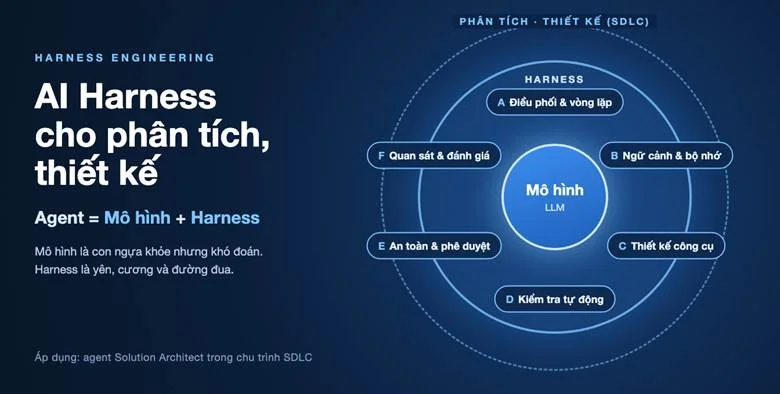
Figure 1: Agent = Model + Harness, with six pillars surrounding the model
From "advisor" to "executor"
Chatbots only answer questions; AI agents make plans on their own, call tools, and take actions in real systems. The problem is that large language models (LLM) operate probabilistically: an agent may run well nine times, and then on the tenth time get stuck in a loop, invent a nonexistent API parameter, or mistakenly delete data. With chatbots, an error is an incorrect answer; with agents, an error is an incorrect action.
What is a Harness?
The harness is everything else in an agent besides the model: orchestration, context, tools, verification mechanisms, guardrails, and observability. The name is derived from a horse's harness: the model is a strong but unpredictable horse; the harness comprises the saddle, reins, and track, which don't make the horse stronger but help direct that power in the right direction.
The term gained popularity in 2/2026 through an article by Mitchell Hashimoto (co-founder of HashiCorp); OpenAI, Thoughtworks, and Anthropic have all published analysis articles. The core principle: whenever an agent makes a mistake, don't just fix the result that time, fix the harness so that the mistake does not recur.
Six pillars of a harness
The first three pillars help the agent work better; the latter three ensure that the agent acts correctly, safely, and measurably.
Orchestration and loops: choosing predefined flows or letting agents plan autonomously; multi-agent coordination; bounding steps, time, and cost; saving state for error recovery and continuation.
Context and memory: delivering the right information at the right time; summarizing context, offloading subtasks to sub-agents, writing progress and documentation to files for subsequent sessions to read.
Tool design: fewer but well-defined tools, parameters that are hard to misuse, error messages written for model comprehension.
Automated testing: tests, linters, schema validation, and architectural rule checks running after each change, returning results for the agent to self-correct.
Safety and approval: sandboxing, least privilege, prompt injection filters; human-in-the-loop approvals based on action reversibility and blast radius.
Observability and evaluation: step-by-step tracing; rerunning eval suites whenever prompts, tools, or models change.
Application to analysis and design: Solution Architect agent
During the coding phase, builds and tests immediately reveal whether something is right or wrong. In the analysis and design phase, the outputs are documents, diagrams, and decisions: there is no "test" for a design, yet errors here cascade into every subsequent step. Therefore, the harness for this phase relies on three layers: structured outputs for traceability, automated checks wherever feasible, and human approval for key decisions.
In the VNPT AI-SDLC framework currently applied in practice, the Solution Architect agent operates strictly according to the six pillars (Figure 2):
Orchestration: predefined flow of input review → directional proposal → technology selection → detailed proposal → approval gate; self-review has a limited number of iterations.
Context: uses only approved requirements and architecture standards; sources read, questions, and decisions are all documented.
Tools: fixed templates for each document type; architecture diagrams follow the C4 model.
Automated checks: diagrams are validated upon writing to file; errors are returned for the agent to self-correct.
Safety and approvals: technology selections are presented as decision records (options, trade-offs, recommendations, rationale); the agent does not approve on its own; unverified infrastructure information is documented as assumptions, without guessing.
Observability: Each run leaves behind a result report and a Q&A log.
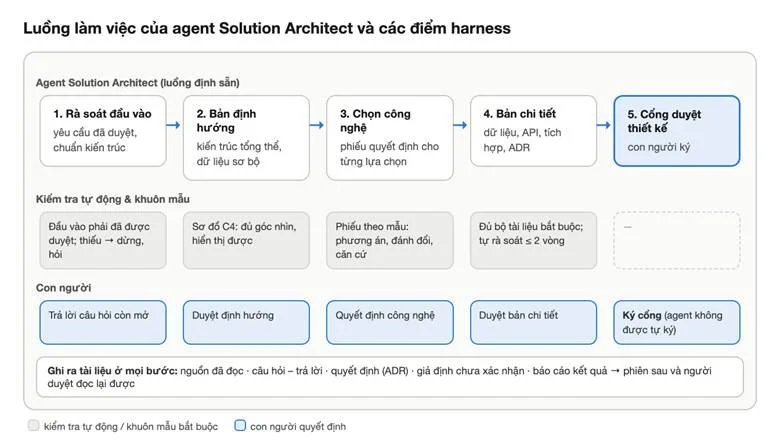
Figure 2: Solution Architect agent workflow and harness points
Two tasks remain difficult: automatically evaluating the quality of a design, and checking consistency across different design documents.
Where to start
There is no need to build all six pillars at once. It should be done sequentially: enable tracing first; set limits on steps, time, and budget; write documentation for the agent to read; review the toolset; connect automated checks; set approval steps for irreversible actions; and build an evals suite from the actual errors encountered.
Conclusion
When powerful models become shared infrastructure via API, the long-term advantage lies in the quality of the harness. In the analysis and design phase, the harness does not replace humans in making architectural decisions, but it helps agents draft within the proper framework, detect errors early on their own, and leave a trail for humans to review more quickly and confidently.